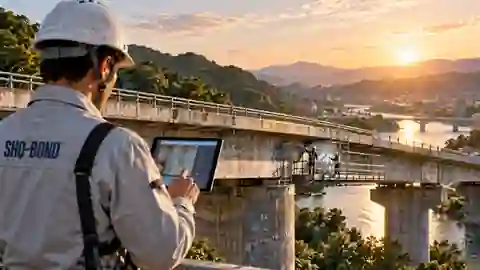
Finding ground anomalies
from space before
people arrive
Synspective's value is not simply in launching many satellites. It is in repeatedly observing wide areas and narrowing down where something has changed and where people should inspect first. If that capability becomes part of routine infrastructure maintenance and disaster response, Synspective could evolve from a space startup into an upstream decision-support infrastructure company.
Sending people everywhere does not scale forever
Roads, railways, levees, ports and telecom infrastructure all need monitoring, but field inspection across wide areas is expensive and sometimes impossible after disasters.
Synspective develops, manufactures and operates small SAR satellites, sells SAR imagery, and provides analytics solutions. It is therefore trying to capture value not only from satellites themselves, but from turning space data into ground-level decisions.
SAR uses microwaves, allowing observation at night and through clouds. Repeated observations can also reveal land displacement over time. Multiple satellites shorten the wait until the next observation; that multi-satellite system is a constellation. The planned 30+ satellites are a means to increase observation frequency, not the end goal.
The business is already moving beyond simply taking images
Can satellites become a filter, not just an eye?
If this works, the social value is not simply "taking pictures from space." It changes how inspection resources are allocated. Satellites do the first screening; people perform detailed inspection where it matters.
The shareholder case therefore depends on moving beyond one large government contract. Roads, railways, ports, telecom operators and overseas governments need to pay repeatedly for monitoring and analytics. The important transition is from winning projects to being paid every year to keep watching.
OMNIA fits the same idea: customers may want assured observation capability rather than a satellite asset. But Synspective's plan for a separate OMNIA constellation also means additional capital will be required.
Seeing change is not the same as preventing failure
- Screening may fail to become a daily workflow. PoCs and emergency use do not automatically become recurring maintenance contracts.
- SAR cannot replace field judgment. Its strongest role may be prioritization rather than final safety assessment.
- Government dependence may remain high. Commercial and overseas recurring revenue still needs to prove itself.
- Satellite-life risk is already real. In Q2 2026, depreciation periods for satellites 4 and 5 were shortened because the company could not guarantee the assumed five-year commercial life.
- Competition is strong. ICEYE and QPS are credible SAR competitors; analytics and workflow integration must differentiate Synspective.
- OMNIA could add capital ahead of demand. A new constellation is attractive only if long-term customer commitments arrive fast enough.
The ability to "see" is proven; changing how society inspects is not
LDM can visualize land displacement over time, disaster-use partnerships are progressing, and defense revenue has begun.
If anomaly candidates can direct human inspection, SAR can support infrastructure maintenance in a labor-constrained society.
Recurring customer workflows and satellite economics still need proof.
Track operational satellites, non-government customers, recurring analytics use, operating cash flow and investment cash flow.
When, and what to check
Operational satellites, revenue conversion of the defense project, non-government customers, operating CF and investing CF.
Check whether the fleet reaches the Q2 company target and whether satellites 4 and 5 remain operational.
Look for LDM and disaster/infrastructure analytics to move from pilots to recurring contracts.
Track initial OMNIA contracts, utilization, revenue per satellite and cash generation after continued fleet investment.
Strong future value; the stock still needs proof beyond government demand
Oct. 8 close
reference
not standalone
The next proof point is recurring payment for anomaly detection and decision support outside the anchor government contract.
Company guidance for 2026 is ¥6.353bn revenue and a ¥5.467bn operating loss, while non-operating items such as subsidies support forecasts of ¥3.010bn recurring profit and ¥2.624bn net profit. That makes the displayed 70.3x P/E a blunt measure of core business profitability.
At the Oct. 8 close, market cap is about 29 times company revenue guidance. The ¥120bn+ backlog is meaningful, but the current valuation also prices in substantial future success.
In September, Synspective arranged a ¥20bn syndicated loan with a 5-year-3-month term for satellite manufacturing and launches. This broadens funding beyond equity, but also adds financial covenants, interest costs and financing expenses. We want to see recurring non-government customers and cash remaining after heavy fleet investment.
Synspective is also scheduled to enter TOPIX on Oct. 30. That may affect near-term trading flows, but it does not change the operating thesis in this note.
Key sources
- Company profile
- Land Displacement Monitoring
- Sinkhole use case
- Disaster imagery agreement
- Ministry of Defense constellation contract
- Synspective OMNIA
- 13th StriX launch
- IR presentations
- IR calendar
- TOPIX inclusion
- Yahoo! Finance 290A
Read next
Explore more companies through the same lens of social change and shareholder value.