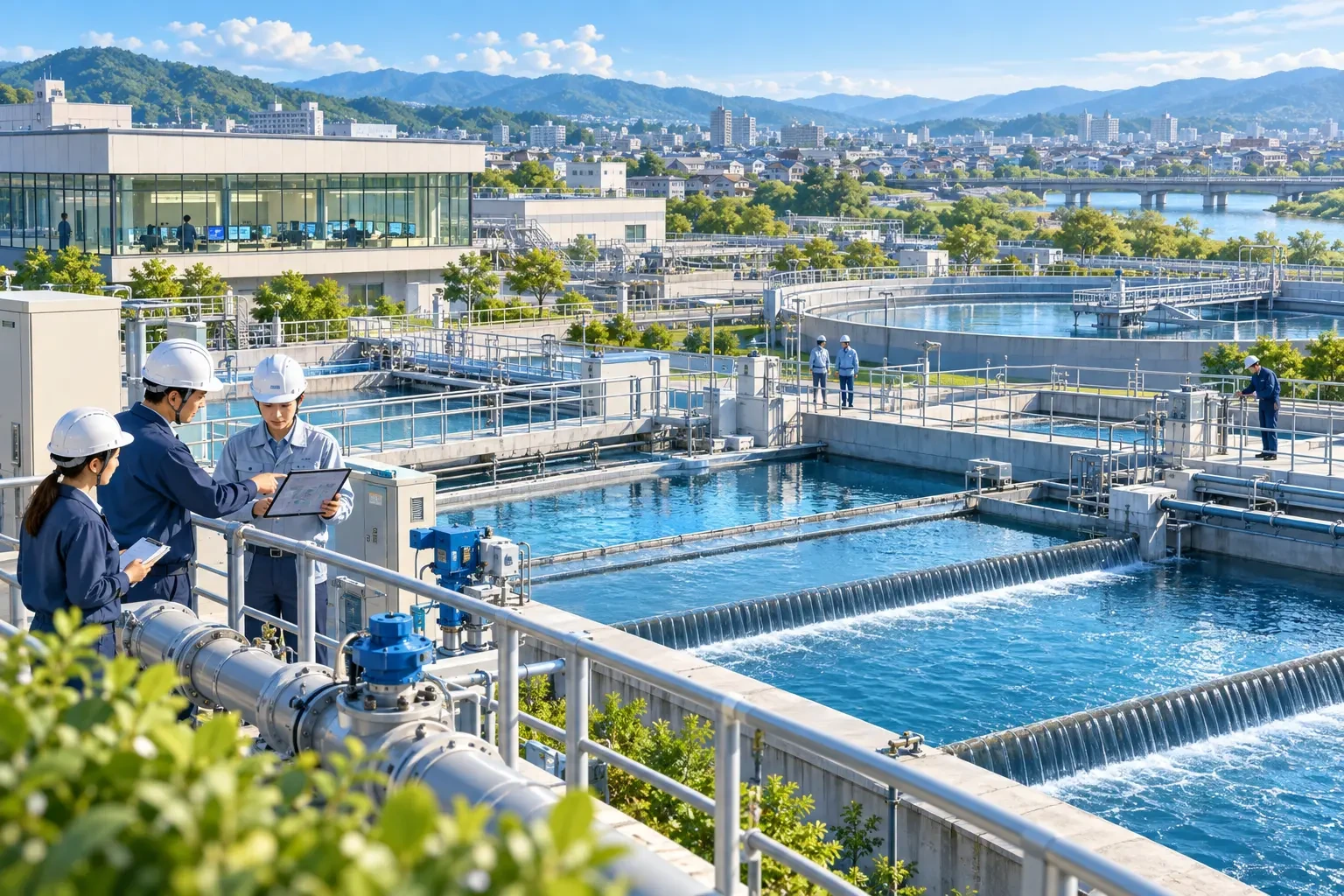
Making Waste Treatment More Efficient:
Takuma
As Japan faces both population decline and aging waste-treatment facilities, Takuma says it has established technology that combines AI combustion control and remote support to enable safe, stable operation with two operators—fewer than before. If that technology can be deployed through plant renewal and long-term operating contracts, reducing labor needs and costs, the essential social function of waste treatment could translate into recurring revenue and shareholder value.
Renewal demand is showing up in earnings, while efficiency technology has reached practical use
What these seven facts tell us
Current growth can largely be explained by aging-facility renewal and a record order backlog, and it is already appearing in revenue and profit. AI-enabled labor saving, lower operating costs and long-term operating contracts are potential mechanisms for turning this demand into recurring income.
However, the number of facilities using AI, actual operating-cost savings and margins on long-term operations are not disclosed. What can be verified today is strong demand and growth in the existing business. The idea that AI will further lift margins and enterprise value remains a hypothesis.
Combine efficiency and long-term operations to align social need with corporate profit
The core of the thesis is a cycle in which AI improves profitability in today's business and those profits are reinvested into future growth. Even if efficiency and long-term operations improve current earnings, the thesis is incomplete if growth investment fails to create the next source of profit.
Social necessity does not guarantee profit growth
- Large-project timing: orders can swing widely with municipal procurement schedules, so a one-year decline does not necessarily signal weaker demand.
- Lower margins: material and labor inflation or errors in long-term contract pricing could prevent backlog from turning into profit.
- AI value becomes commoditized: labor-saving technology could become a standard feature required to win bids rather than a source of premium pricing or service revenue.
- Facility consolidation: the company itself expects future renewal demand and the number of operating facilities to decline as population falls. Today's renewal cycle will not last forever.
- Lack of growth opportunities: the size of shareholder returns is not itself the risk. The risk is failing to find attractive investment opportunities or turn new technology and businesses into profit, which could limit growth after 2030.
Demand and technology are visible; the incremental profit from AI and future growth is not
We can verify renewal demand, record backlog, revenue and profit growth in the domestic environmental business, AI labor-saving technology and long-term operating models. Capital allocation currently favors shareholder returns over growth investment.
The number of AI installations, margin improvement and effect on repeat orders are undisclosed. Earnings from acquisitions and CO₂ capture also remain to be proven.
We will watch domestic environmental margins, recurring-revenue growth and the balance between growth investment and shareholder returns in the next plan.
Watch whether backlog becomes profit and recurring revenue
Earnings growth is visible, but the shares are not deeply discounted
Our view at publication: renewal demand, record backlog and the dividend make Takuma a credible long-term candidate. We do not, however, view the current price as deeply undervalued; we want evidence that AI and growth investment create the next layer of profit.
A forward P/E of 13.98x is not extreme relative to current earnings expectations. Aging-facility renewal and record backlog are already converting into revenue and profit, so the multiple looks reasonable if current earnings persist. However, annual profits can swing with the timing of large projects, and backlog alone does not guarantee future earnings.
A P/B of 1.94x means the market values Takuma at nearly twice book equity, so it is not cheap on asset value alone. Trailing ROE of 12.4%, however, shows that the company is generating meaningful profit from equity, providing a reason for valuation above book. To sustain that premium, the company needs to show healthy margins in the domestic environmental business, more recurring revenue from long-term operations and maintenance, and measurable economics from AI-enabled labor saving.
The forecast dividend is ¥108 per share, implying a 3.59% yield. Takuma targets the higher of 50% of profit or 4% of equity as its distribution benchmark, making shareholder-return policy clear. But over FY2024–FY2026, shareholder returns exceed planned growth investment. The return policy is attractive, while long-term growth after 2030 depends on whether acquisitions, R&D and CO₂ capture investment create new earnings.
Overall, current earnings and dividends are attractive, but a 1.94x P/B already reflects expectations for returns above book value. In upcoming results we will focus on domestic environmental margins and recurring revenue; in the next plan, we will focus on the results of growth investment and the balance with shareholder returns. Market data
Metrics are based on the Sep. 28, 2026 closing price. This is a subjective assessment based on public information and the thesis in this article.
Sources
- Takuma — Digital technology
- Takuma — FY2027/3 Q1 supplementary materials
- Takuma — FY2026/3 results briefing
- Takuma — Management conscious of cost of capital and share price
- Takuma — Financial and non-financial data
- Takuma — CO₂ separation and capture demonstration plan
Read next
Explore more companies through the same lens of social change and shareholder value.