
It Reached a Tumor. Can It Treat It? PeptiDream's Next Test
Peptide-based radiotherapy is already a real medical treatment. But PeptiDream's own kidney-cancer candidate has yet to prove that it improves outcomes.
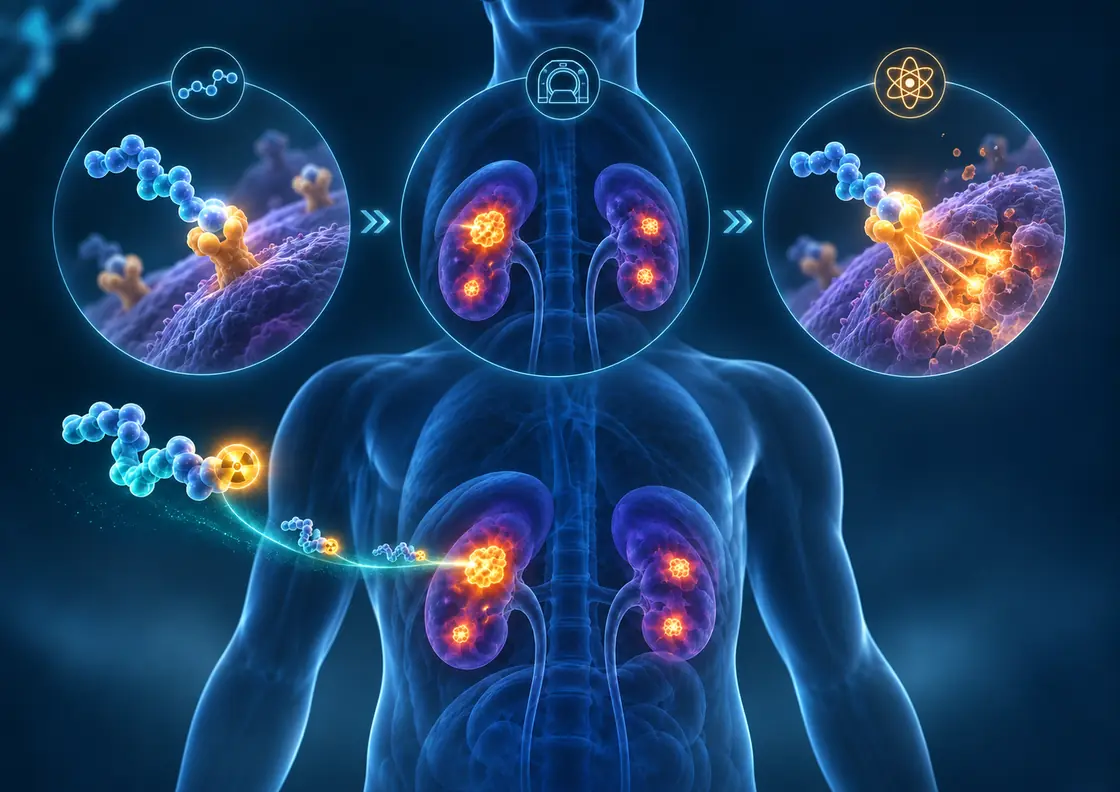
In a five-patient imaging study involving clear-cell kidney cancer, PD-32766 accumulated in many tumor lesions. A US Phase 1 study began in July 2026. Can the discovery platform, combined with a large manufacturing investment, deliver a viable therapy and sustainable earnings?
The method has worked; this particular drug is still experimental
Lutathera, a peptide radiopharmaceutical, was approved by the FDA in 2018 for a defined group of neuroendocrine tumors. It was not developed by PeptiDream.
PD-32766 targets CA9, a marker common in clear-cell kidney cancer, and was studied using copper-64 for imaging. Actinium-225 is being tested for therapy. The clinical outcomes of the first drug cannot be extrapolated to this candidate.
What has been demonstrated?
Can a molecule become repeat revenue?
The possibility is to evolve from volatile licensing milestones to product earnings. But imaging uptake is not a demonstration of therapeutic benefit.
Some current diagnostic products are not derived from PeptiDream's peptide platform.

Why the hypothesis might fail
- Clinical results:An imaging signal may not translate into efficacy or acceptable safety.
- Competition:Novartis, Telix and others have established or advanced programs.
- Hospitals:Facilities and specialist staff may limit uptake.
- Capital intensity:The ¥16.5bn plant must earn returns after manufacturing and quality costs.
Uptake observed; efficacy and economics remain to be demonstrated
An approved peptide therapy exists elsewhere; PD-32766 has entered Phase 1.
Commercialization may generate repeat earnings.
A five-patient study does not establish therapeutic benefit.
Review product segment margins and cash flow.
Next tests
Check radio segment earnings and full-year guidance.
Separate imaging data, toxicity and outcomes.
Review approvals, output and financing.
What does a ¥145.5bn valuation assume?
Its discovery capability is credible. Repeatable earnings are not yet proven.
At the Nov. 2, 2026 close of ¥1,119, market capitalization was about ¥145.5bn. Against the company's ¥3bn forecast net profit, that is roughly 48x earnings. The valuation rests on more than today's profits.
PeptiDream's success is not merely a lucky deal: partnerships with Novartis, MSD and other major drug makers have produced development progress and milestone payments. Still, a major agreement helped deliver roughly ¥15bn in net profit in 2024; in 2025, a planned licensing deal was not signed by year-end. Revenue of about ¥18.5bn fell far short of the original ¥49bn forecast, and the company posted a net loss of roughly ¥3.7bn. Repeated scientific progress does not necessarily mean repeatable profits.
Governance remains a concern. A 2025 investigation found that a former deputy executive had removed, or likely removed, up to ¥54m in laboratory reagents without authorization, exposing weaknesses in internal controls. The company announced remedial measures and hired three leaders with operations, strategy and talent-development experience in July 2026. Whether stronger management will translate into effective oversight and earnings remains unproven.
At a hypothetical 25x earnings multiple, sustained net profit of ¥6bn would imply ¥150bn in market value, and ¥10bn would imply ¥250bn. These are simple scenarios, not forecasts; future valuation multiples and share counts may change.
The radiopharmaceuticals business earned only about a 3% segment margin in the first half of 2026. The new plant must ultimately turn approvals and supply capabilities into durable profits.
The ambition to treat cancer in new ways is compelling. But the price already anticipates future commercial success. Further upside requires proof of earnings, not only progress in the lab.
Sources
- PeptiDream: special investigation findings
- PeptiDream: internal-control remediation
- PeptiDream: three executive hires in July 2026
- PeptiDream: 2024 Novartis agreement
- PeptiDream: MSD milestone and PDPS licensing
- PeptiDream: 2025 earnings guidance revision
- PeptiDream: 2025 results
- 米FDA:ルタテラの承認
- NETTER-1臨床試験
- 国立がん研究センター:5人の研究
- ペプチドリーム:第Ⅰ相開始
- 開発品一覧
- 千葉県:PDRファーマ工場
- Telix:2026年10月時点の開発状況
- 2026 interim results
- PeptiDream: November 11 earnings calendar
- 11月2日株価
Read next
Explore more companies through the same lens of social change and shareholder value.