DOWA Processed Circuit Boards 14 Years Before Its Mines Closed
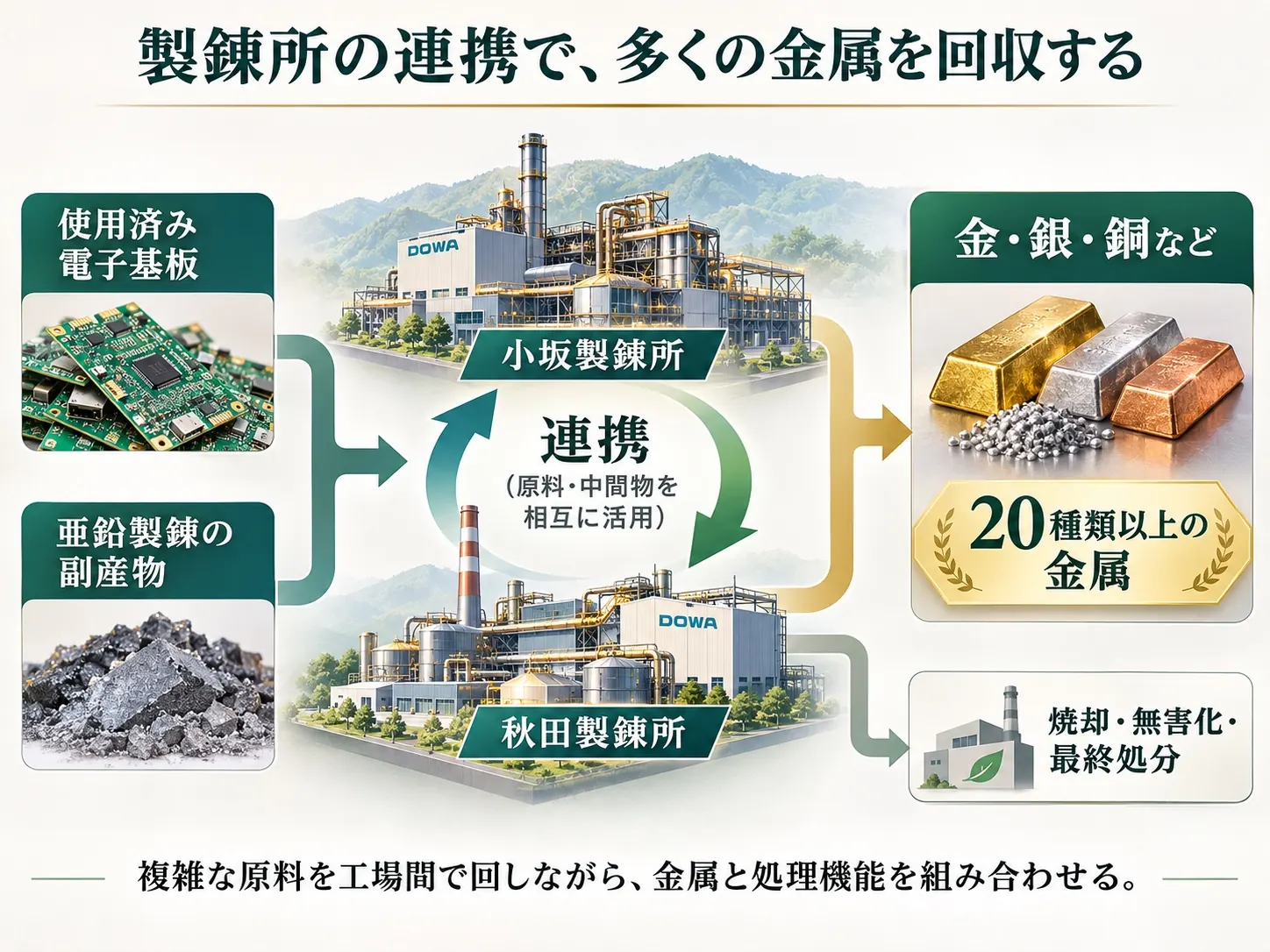
In 1980, DOWA began processing discarded circuit boards—14 years before its last domestic mines closed. Skills developed to recover gold, silver and copper from complex kuroko ore were already finding new feedstocks. A dedicated recycling smelter began full operations in 2008.
The challenge now is not simply extracting metals. It is buying scrap at the right price and leaving a profit after processing. Environmental benefits and shareholder returns require different tests.
Much of the world's discarded metal is still unrecovered
Global e-waste reached roughly 62 million tonnes in 2022. Just 22.3% was documented as formally collected and recycled; the total is projected to reach about 82 million tonnes in 2030.
Japan aims for roughly 30% of domestically refined copper to come from recycled feedstocks by 2030. Meeting demand requires more than processing technology: smelters must source suitable scrap and earn enough to process it.
46 years after circuit-board recovery began, smelting drives today's profits
Can the skill of separating metals become a skill of buying scrap?
By the 2030s, competition could drive up purchase prices for clean, high-grade scrap. Mixed-material scrap is harder to evaluate and process. DOWA's multi-metal experience and network may create an edge where other buyers struggle to assess value.
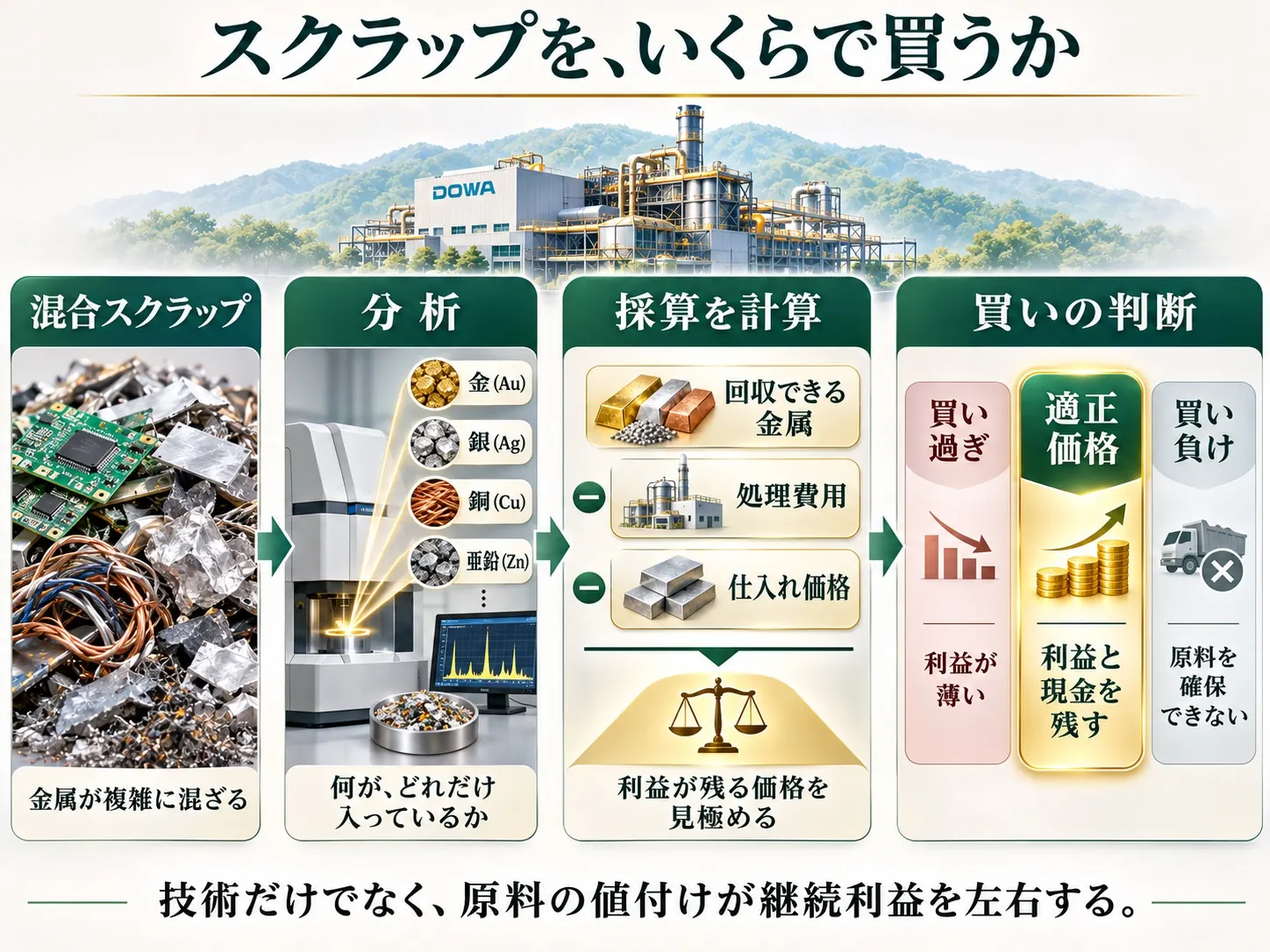
The economic edge would lie in valuing inputs, not merely operating a furnace. DOWA does not disclose enough scrap-level procurement economics to confirm that advantage today.
Winning on technology could still mean losing on price
- Scrap bidders push procurement costs higher, squeezing margins despite rising volumes.
- More than ¥100bn for smelting and recycling site renewal and depreciation fail to generate commensurate returns.
- Battery and magnet recovery processes fail commercial yield, quality or cost tests.
- Metals prices, FX and overseas mining earnings overshadow any improvement in recycling economics.
Recovery is established; a sourcing edge and investment returns are unproven
A linked smelter network already recovers multiple metals commercially.
Could analysis and smelting expertise improve purchase decisions?
Margins and cash returns matter as much as volumes.
Measure difficult-feedstock throughput and post-investment profit.
Measure profits, not just completion of construction
Review smelting and recycling margins and recycled-feedstock activity.
Separate essential equipment renewal from new feedstock capacity.
Track difficult scrap, processing margins and cash flow after capex.
Shares rose 11% after earnings. Will the profits last?
At the Nov. 12 close of ¥8,613 (+10.92%), P/E is roughly 7.3x if FY2027's ¥70bn earnings persist—but about 11.3x if sustainable net profit is ¥45bn.
After the Nov. 11 close, DOWA raised FY2027 earnings guidance from ¥57bn to ¥70bn, the annual dividend forecast from ¥338 to ¥415 a share, and announced up to ¥16bn in buybacks.
FY2026 net income was about ¥62.5bn, including roughly ¥25bn in securities-sale gains. Deducting an illustrative 30% after-tax portion (~¥17.5bn) yields about ¥45bn; this still contains metals-market tailwinds. Profit in FY2023–25 was ¥25–27.9bn.
At the same ¥8,613 share price, different multi-year earnings conditions imply:
Only a modest improvement from FY2023–25 earnings. P/E around 17.0x.
FY2026 profit excluding estimated after-tax securities gains continues. P/E around 11.3x.
The FY2027 company forecast is sustained. P/E around 7.3x.
Our current assessment: not a clearly undervalued buy. AI-server-related demand is another potential profit engine. Yet we still need evidence that recycling growth and heavy capex turn into durable profits and cash. The question is which earnings level an investor is paying for.
Share price and market metrics as of Nov. 12, 2026 Tokyo close. Scenario P/E uses about 59.16m shares excluding treasury. The ¥45bn estimate assumes 30% tax on securities gains and is not management's normalized earnings forecast.
Sources
- Environment Ministry: DOWA smelting and recycling history
- DOWA: Earnings by business segment
- DOWA: FY2027 first-half earnings drivers
- DOWA: Smelting and multi-metal recovery
- JBMA: On-site account of Kosaka smelter
- Kabutan: November 12 share price
- DOWA: Interim results and buyback, Nov. 11, 2026
- DOWA: Five-year earnings
- DOWA REPORT 2025: business and history
- DOWA: Medium-term Plan 2027
- Japan Environment Ministry: Metals recycling strategy
- ITU/UNITAR: Global E-waste Monitor
- DOWA: Battery metal recovery
- DOWA: Rare-earth magnet demonstration
- JX Advanced Metals: Smelting and recycling
- Mitsubishi Materials: Smelting and circulation
- Matsui Securities: Share price and ratios
Read next
Explore more companies through the same lens of social change and shareholder value.